
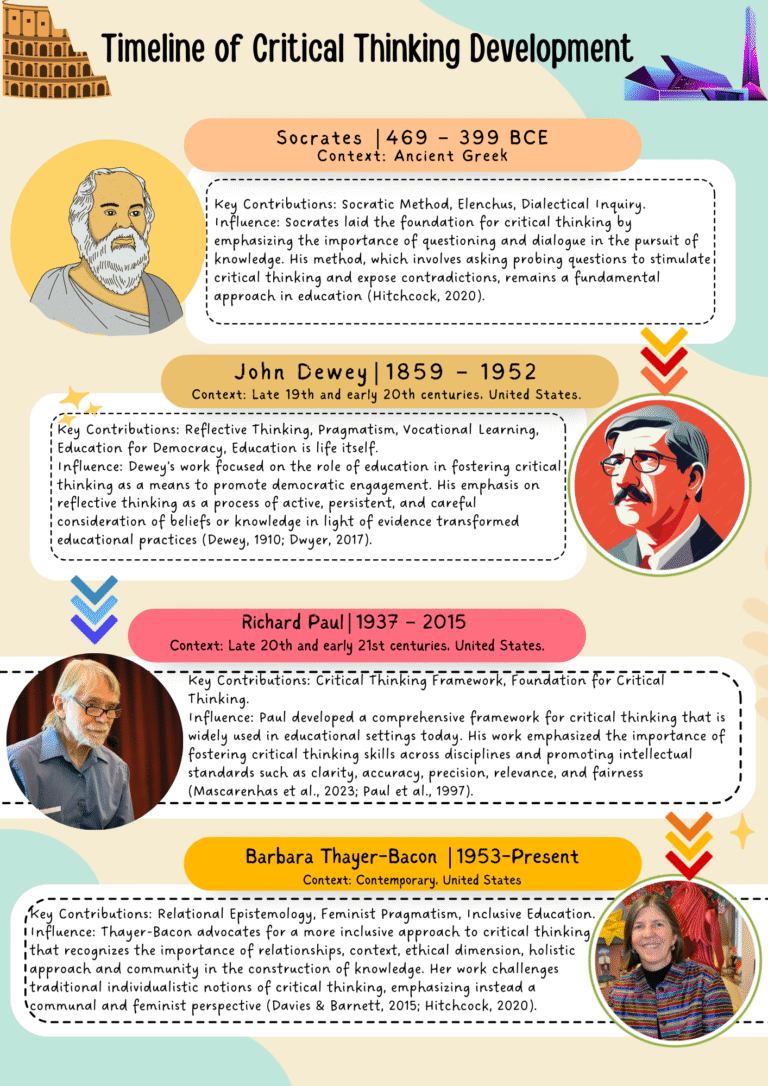
Annotated Timeline Showcasing the Development of the Concept of Critical Thinking
Introduction
Critical thinking is widely regarded as a cornerstone of education, essential for problem-solving, decision-making, and meaningful engagement with the world. The development of this skill has been significantly shaped by several key thinkers, each contributing distinct ideas that have influenced contemporary educational theory and practice. This essay will explore the contributions of four pivotal figures in critical thinking: Socrates, John Dewey, Richard Paul, and Barbara Thayer-Bacon. It will begin by examining the foundational ideas introduced by each thinker, followed by an analysis of how these ideas have evolved over time. An infographic timeline will illustrate the key contributions and influence of each thinker in the development of critical thinking theory. By placing their contributions within their historical contexts, the essay aims to highlight the enduring relevance of these insights and their impact on modern educational practices. This comprehensive analysis will provide a deeper understanding of how these diverse perspectives continue to shape and enhance critical thinking in education today.
Critical Analysis of four Thinkers’ Contributions
The evolution of critical thinking in education can be traced back to the ancient world, with Socrates as one of its earliest proponents. His approach, often referred to as the Socratic Method, laid the groundwork for what would become a central component of critical thinking: the practice of questioning. Socrates’ method of dialectical inquiry, where knowledge is pursued through dialogue and the systematic questioning of assumptions, is considered foundational to the development of critical thinking (Hitchcock, 2020). Socrates believed that through persistent questioning, individuals could uncover the truth or at least become aware of their own ignorance. This method encourages a deeper understanding of concepts and challenges learners to think more critically about their beliefs and assumptions.
Socrates’ influence on critical thinking is profound, as his method is still widely used in education today, particularly in the fields of philosophy, law, and education. However, it is essential to recognize that Socratic questioning, while powerful, can also be seen as confrontational, which may not always be conducive to learning in all contexts. The method assumes a certain level of prior knowledge and intellectual rigor that may not be accessible to all learners, potentially leading to feelings of inadequacy or frustration (Dwyer, 2017). For instance, in a classroom using the Socratic Method, students are expected to engage in deep questioning. However, if they lack foundational knowledge or critical thinking skills, they may struggle, leading to frustration or feelings of inadequacy. Instead of fostering engagement, the method can alienate learners unprepared for its intellectual demands. Despite these criticisms, Socrates’ contribution to the development of critical thinking is undeniable, as he established the importance of dialogue and inquiry in the pursuit of knowledge.
Moving forward in time, the work of John Dewey represents a significant shift in the conceptualization of critical thinking. Dewey’s contributions are rooted in pragmatism, a philosophical tradition that emphasizes the practical application of ideas. Dewey argued that education should be centered on the development of critical thinking skills, which he referred to as “reflective thinking” (Dewey, 1910). For Dewey, reflective thinking was not just about questioning but about actively engaging with and responding to problems in a way that is informed by experience and evidence. He believed that education should prepare individuals to participate in a democratic society, where critical thinking is essential for informed decision-making and social progress (Davies & Barnett, 2015).
Dewey’s emphasis on education as a means of fostering critical thinking had a profound impact on educational practices, particularly in the United States. His ideas contributed to the progressive education movement, which advocated for experiential learning and the development of problem-solving skills. Dewey’s approach to critical thinking is both practical and democratic, making it accessible and relevant to a wide range of learners. However, some critics argue that Dewey’s focus on experience and practical outcomes may overlook the importance of theoretical knowledge and the role of abstract thinking in education (Mascarenhas et al., 2023). For instance, in a classroom focused on Dewey’s experiential learning, students might engage in practical activities like building models to understand engineering concepts. However, critics argue that this approach might neglect teaching the underlying theoretical principles, such as the physics and mathematics behind structural integrity. As a result, students might excel at hands-on tasks but struggle to grasp more abstract concepts like algebra or calculus, which are essential for higher-level problem solving in real-world engineering scenarios. Without a balance between practical experience and theoretical knowledge, students could face challenges in more advanced studies. Nonetheless, Dewey’s work remains a cornerstone of modern educational theory, particularly in its emphasis on the importance of critical thinking in fostering democratic participation.
In contemporary era, Richard Paul offers a more structured and systematic approach to critical thinking. As one of the leading figures in the field, Paul developed a comprehensive framework that outlines the essential components of critical thinking, including intellectual standards such as clarity, accuracy, precision, relevance, and fairness (Willingham & NSW Department of Education, 2019). Paul’s framework is widely used in educational settings, providing a clear and practical guide for teaching and assessing critical thinking skills.
Paul’s contributions to critical thinking are particularly valuable in their emphasis on the need for systematic and disciplined thinking. His framework provides educators with the tools to foster critical thinking in students across various disciplines, making it a versatile and widely applicable approach (Dwyer, 2017). However, some critics argue that Paul’s framework, while comprehensive, may be overly prescriptive and rigid, potentially stifling creativity and independent thinking (Davies & Barnett, 2015). Despite these criticisms, Paul’s work remains highly influential in the field of education, particularly in its emphasis on the importance of intellectual standards in critical thinking.
Barbara Thayer-Bacon, a contemporary of Richard Paul, represents a significant departure from traditional notions of critical thinking, particularly with her emphasis on relational epistemology and feminist pragmatism. Thayer-Bacon challenges the individualistic and often adversarial nature of traditional critical thinking, advocating instead for an approach that recognizes the importance of relationships, community, and context in the construction of knowledge (Hitchcock, 2020). Her work is grounded in feminist theory, which critiques the ways in which traditional epistemologies have marginalized certain voices and perspectives.
Thayer-Bacon’s relational approach to critical thinking is particularly relevant in today’s diverse and interconnected world. She argues that knowledge is not something individuals possess in isolation but is instead constructed through relationships and interactions with others. This perspective challenges the notion that critical thinking is purely an individual cognitive process and emphasizes the importance of collaboration and dialogue (Hitchcock, 2020). However, her approach has also faced criticism for potentially downplaying the importance of individual autonomy and the ability to critically assess one’s own beliefs and assumptions (Paul et al., 1997). For instance, in a group project setting where Thayer-Bacon’s approach is applied, the focus might be on collaboration and consensus-building. While this fosters a sense of community, critics argue that it could diminish individual autonomy. A student who disagrees with the group may feel pressured to conform to the collective view rather than critically assess and defend their own perspective. As a result, the student’s ability to challenge assumptions or think independently might be weakened in favor of maintaining group harmony. Nevertheless, Thayer-Bacon’s work has significant implications for education, particularly in promoting more inclusive and equitable learning environments.
Conclusion
In conclusion, the evolution of critical thinking within education has been profoundly shaped by the seminal contributions of Socrates, John Dewey, Richard Paul, and Barbara Thayer-Bacon. Socrates introduced the dialectical method, emphasizing questioning and dialogue as a means to uncover truth. John Dewey expanded this by integrating experiential learning, underscoring the importance of reflection and active engagement in the learning process. Richard Paul provided a structured framework, focusing on intellectual standards such as clarity and fairness, to systematically enhance critical thinking skills. Barbara Thayer-Bacon, on the other hand, highlighted the relational aspects of knowledge, advocating for a collaborative approach that values community and context. Despite their differing perspectives, each thinker has underscored the crucial role of questioning, reflection, and dialogue in education. As educational challenges continue to evolve, their insights remain essential, guiding educators in nurturing critical thinking and equipping learners to tackle complex problems in the 21st century.
References
Davies, M., & Barnett, R. (Eds.). (2015). The Palgrave handbook of critical thinking in higher education. Palgrave Macmillan.
Dewey, J. (1910). How we think. DC Heath & Co Publishers.
Dwyer, C. P. (2017). Critical thinking: Conceptual perspectives and practical guidelines. Cambridge University Press.
Hitchcock, D. (2020). Seven philosophical conceptions of critical thinking: Themes, variations, implications. In Critical Thinking and Reasoning (pp. 9-30). Brill.
Mascarenhas, O. A. J., Thakur, M., & Kumar, P. (2023). A primer on critical thinking and business ethics. Emerald Publishing.
Paul, R., Elder, L., & Bartell, T. (1997). California teacher preparation for instruction in critical thinking: Research findings and policy recommendations. Retrieved from ERIC – ED437379 – California Teacher Preparation for Instruction in Critical Thinking: Research Findings and Policy Recommendations. https://eric.ed.gov/?id=ED437379
Willingham, D. T., & NSW Department of Education. (2019). How to teach critical thinking. https://education.nsw.gov.au/teaching-and-learning/education-for-a-changing-world/thinking-skills/how-to-teach-critical-thinking